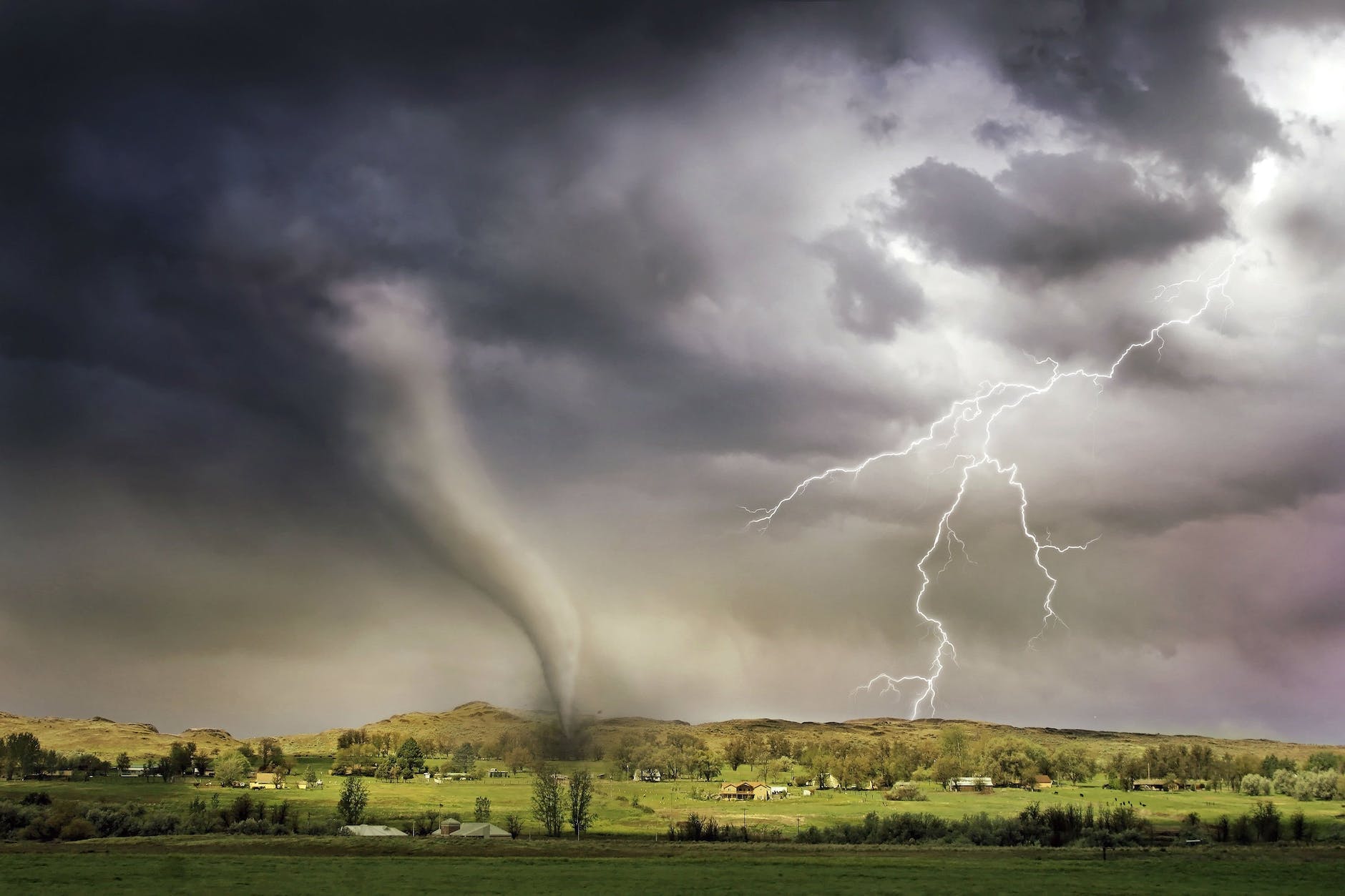
“At last,” I hear you say, “an Emily Dickinson poem.” One of my many New Year resolutions is to read more of Emily Dickinson. Although it is not tornado season, the extreme weather conditions we are experiencing can produce tornadoes “out of season” and often “out of place.” A few weeks ago a tornado was reported in Manchester, England! When people describe a “tornado moment”, we often hear them describe the noise of the wind similar to that of a freight train! Dickinson describes the sound of the wind like that of a bugle. Take time to savor the words she uses to describe this storm – wind quivered, the cold air as a green chill, the tornado itself becomes an emerald ghost, the thunder and lightening an electric moccasin as it surrounded you. The trees left panting and the fences fled. For Dickinson living in the late 1800s such an experience of a tornado was local, it did not change the world, and most of the world knew nothing about it. Because life has changed with immediate news from the places furthest from us it means that we are all affected emotionally by such storms! Enjoy this poem and pause to enjoy her choice of words as she paints such a vivid picture of such a storm. What words might you use to paint a storm? Please note her last thought.
There came a Wind like a Bugle-
There came a wind like a bugle;
It quivered through the grass,
And a green chill upon the heat
So ominous did pass
We barred the windows and the doors
As from an emerald ghost;
The doom’s electric moccasin
That very instant passed.
On a strange mob of panting trees,
And fences fled away,
And rivers where the houses ran
Those looked that lived—that Day—
The bell within the steeple wild
The flying tidings whirled.
How much can come
And much can go,
And yet abide the world. Emily Dickinson (1830-1886)
Prayer:
Holy God,
your breath and wind are
creative and loving, as you ushered
our world into being.
Breathe your love and grace upon
me, and upon all people.
Holy God,
amidst all the chaos of war and hunger,
all the chaos of fear and foreboding, might
your breath gently fill my soul, as a gentle
wind fills the sail of a boat. So move me on
in life with courage to overcome the chaos ,
with love to overcome the hate, with generosity
to overcome the greed, and with faith to overcome
all fear.
Holy God,
blow away the cobwebs of my doubts and
by the wind of your Spirit revive my soul. Amen.
 Prayers, Poems, and Christian Ponderings
Just this week I saw a friend’s photos of Waltham Mill. Apparently it still has all 6 sails still working, and is perhaps the only one in Britain like this. It made me think of all the abandoned mills we see traveling across the midwest. They are often overgrown with vines and have an old fashioned yet charming look to them. I wonder if one day people will look at the new wind turbines in the same way.
Wind is certainly one of nature’s more fickle phenomena, but one we need. I love its sound during a Nor’easter, like someone trying to blow out 100 birthday candles without taking a breath. I love when it blows hard across the plains and helps disperse the stench of the stockyards. It brings us electricity, fuels our sails on the water and makes waves across wheat fields. I dislike it when it brings the destruction of a tornado, turns umbrellas inside out and sends trashcans into the yards of neighbors.
I enjoyed the poem, and the reminder that for several years I’ve been reading The Life of Emily Dickinson, by Richard Sewall. I need to continue or I will never finish it. It is known affectionately as the “thickest, heaviest paperback in our house”, literally and figuratively. But for insight into the poet, it is a fantastic read.
LikeLike