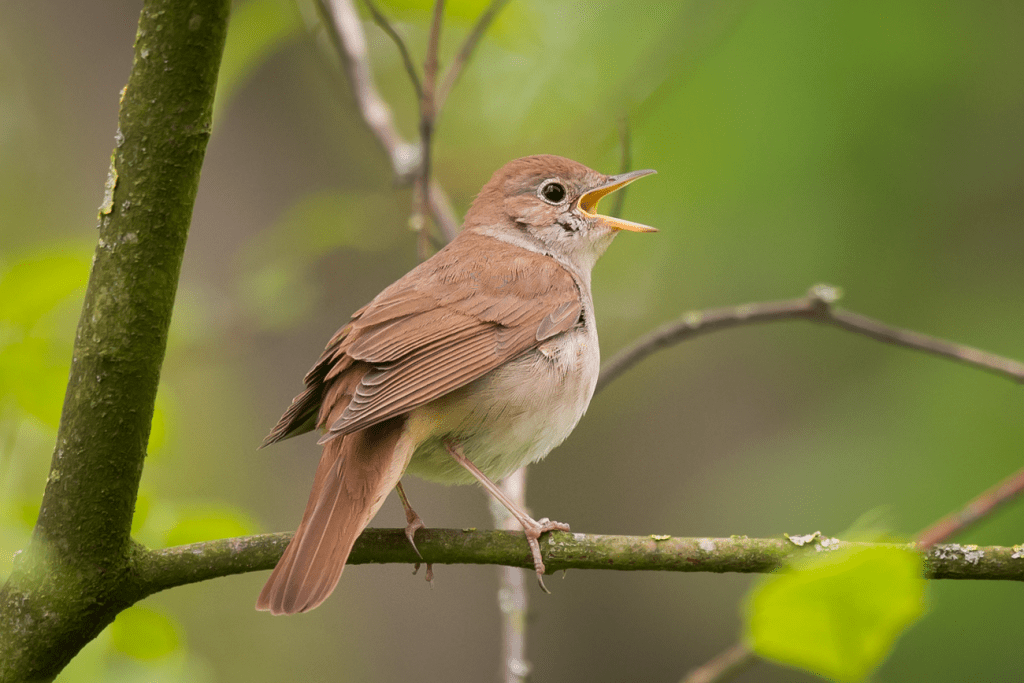
The poem Ode to a Nightingale by John Keats (1795-1821) is regarded by many as a classic. There are just too many great lines to count, it might be easier to number the not so good lines of the total of 80 that make up the poem. Keats writes from a drowsy numbness as if he had taken a drug and in this semi wakeful state he hears the nightingale sing from somewhere deep in the forest. The joyful song of the bird causes Keats to be happy in the bird’s happiness. The poet longs for a draught of vintage, his desire being that the wine helps him escape all the troubles of the world and the certainty of our own mortality. “Where but to think is to be full of sorrow” He desires to escape by following the bird, his escape is not through wine, mentioning the Roman god of wine Bacchus being carried on a chariot of leopards, rather his escape is through poetry (poesy) and creative imagination. Keats draws on Greek mythology, in stanza 1 Lethe – river of forgetfulness in Greek underworld, Dryad – female spirits of forest and groves. Stanza 2 Hippocrene – Greek mythology – fountain on Mt Helicon to drink from to restore poetic imagination! Keats thinks of the bird and its song as immortal, this song that he hears was heard generations and centuries before by emperor and clown, even by Old Testament Ruth in her homesickness. In the last two lines he asks, was all this a vision or a dream? What does he choose – to wake or sleep?
Please enjoy this poem and all its beauty and be ready to listen so attentively to the song of the nightingale. Amidst our own “weariness, fever and fret” in the present turmoil of our world, near or far, war or peace, plenty or hunger, poverty or riches, good fortune or chaotic tragic existence, still the nightingale sings the same happy song for all to hear. We so need this happy song amidst the weight of war and the tears of tragedy. Let us not tire of praying for the peoples of Ukraine, Gaza or Israel, and the all too many families in grief from the unending sickness of gun violence in our own city of St. Louis and throughout this nation.
Ode to a Nightingale (1820) John Keats
My heart aches, and a drowsy numbness pains
My sense, as though of hemlock I had drunk,
Or emptied some dull opiate to the drains
One minute past, and Lethe-wards had sunk:
‘Tis not through envy of thy happy lot,
But being too happy in thine happiness–
That thou, light-winged Dryad of the trees,
In some melodious plot
Of beechen green, and shadows numberless,
Singest of summer in full-throated ease.
O, for a draught of vintage! that hath been
Cooled a long age in the deep-delved earth,
Tasting of Flora and the country green,
Dance, and Provençal song, and sunburnt mirth!
O for a beaker full of the warm South,
Full of the true, the blushful Hippocrene
With beaded bubbles winking at the brim,
And purple-stained mouth;
That I might drink, and leave the world unseen,
And with thee fade away into the forest dim:
Fade far away, dissolve, and quite forget
What thou among the leaves hast never known,
The weariness, the fever, and the fret
Here, where men sit and hear each other groan;
Where palsy shakes a few, sad, last gray hairs,
Where youth grows pale, and spectre -thin, and dies;
Where but to think is to be full of sorrow
And leaden-eyed despairs;
Where Beauty cannot keep her lustrous eyes,
Or new Love pine at them beyond to-morrow.
Away! away! for I will fly to thee,
Not charioted by Bacchus and his pards,
But on the viewless wings of Poesy,
Though the dull brain perplexes and retards:
Already with thee! tender is the night,
And haply the Queen-Moon is on her throne,
Clustered around by all her starry Fays;
But here there is no light,
Save what from heaven is with the breezes blown
Through verdurous glooms and winding mossy ways.
I cannot see what flowers are at my feet,
Nor what soft incense hangs upon the boughs,
But, in embalmèd darkness, guess each sweet
Wherewith the seasonable month endows
The grass, the thicket, and the fruit-tree wild;
White hawthorn, and the pastoral eglantine;
Fast fading violets covered up in leaves;
And mid-May’s eldest child,
The coming musk-rose, full of dewy wine,
The murmurous haunt of flies on summer eves.
Darkling I listen; and, for many a time
I have been half in love with easeful Death,
Called him soft names in many a musèd rhyme,
To take into the air my quiet breath;
Now more than ever seems it rich to die,
To cease upon the midnight with no pain,
While thou art pouring forth thy soul abroad
In such an ecstasy!
Still wouldst thou sing, and I have ears in vain–
To thy high requiem become a sod.
Thou wast not born for death, immortal Bird!
No hungry generations tread thee down;
The voice I hear this passing night was heard
In ancient days by emperor and clown:
Perhaps the self-same song that found a path
Through the sad heart of Ruth, when, sick for home,
She stood in tears amid the alien corn;
The same that oft-times hath
Charmed magic casements, opening on the foam
Of perilous seas, in faery lands forlorn.
Forlorn! the very word is like a bell
To toll me back from thee to my sole self!
Adieu! The fancy cannot cheat so well
As she is famed to do, deceiving elf.
Adieu! adieu! thy plaintive anthem fades
Past the near meadows, over the still stream,
Up the hill-side; and now ’tis buried deep
In the next valley-glades:
Was it a vision, or a waking dream?
Fled is that music: – Do I wake or sleep?
Prayer:
Eternal and all loving God,
help me not to seek escape through dream or sleep.
Keep me awake in this troubled world
that I might hear the songs of the birds,
that I might hear the cry of the new born child,
that I might hear the cheer which welcomes
yet another survivor from days under wreckage.
Holy God, keep me awake
that I too might hear the deep cries of grief,
that I too might hear the silence of death in families
where there should have been the merry sound
of children and parents at play and at work.
Save me from weariness, fever and fret.
Keep hope alive in my soul that I too
might sing a song of love and grace,
which might move the world a little closer
to the joy of the Creator.
Hear this my prayer and my song, today and through the night. Amen.
 Prayers, Poems, and Christian Ponderings
Each day in the early morning hours before kitchen lights come on one by one in the neighborhood, my coffee and I spend some time on the porch listening to the birds and enjoying the perception of peace. It feels good to start the day in this manner. But yesterday I came back inside and opened my computer only to find a notification from The NY Times, “A Map of Every Fatal Shooting in the US since 2020”. Why in the world would I want to start my day with that information. We do indeed need the birdsong and even in the dissonance it brings, it can soothe. Sometimes however, the reality of this world is louder than the nightingale.
LikeLike